
Introduction: The Tectonic Shift in Digital Marketing
Let’s be honest. For the last few years, the term “AI in marketing” felt like a buzzword—a futuristic promise splashed across presentation slides. We’ve all used an AI writing tool, dabbled in automated email sequences, or relied on a smart bid strategy in our ad platforms. It was cool, it was helpful, but it still felt like a tool—something we picked up, used, and then put down.
But that’s over.
The shift happening right now isn’t about better tools; it’s about the rise of AI Agents. Think of it this way: a tool is a hammer you use to hit a nail. An AI agent is a self-driving robotic carpenter that not only hammers the nail but checks the blueprint, measures the force, adjusts for wood density, and then reports back on the structural integrity—all without you lifting a finger.
The marketing platforms we use every single day—Google Ads, Facebook, HubSpot, your CRM—are no longer just hosting AI features. They are becoming integrated ecosystems for autonomous, decision-making agents.
Here at DigitalDhruv, we don’t just teach digital marketing; we help you see around the corner. We believe that understanding AI agents in digital marketing is the single most critical skill for any marketer or business owner who wants to thrive, not just survive, in the next five years. This is the future of marketing platforms, and it’s already here.
In this deep dive, we’ll break down exactly what these agents are, where they are landing on your favourite marketing platforms, and how you can ride this wave of Marketing Automation to unprecedented success.
1. Demystifying the Term: AI Tools vs. AI Agents
To truly grasp this new reality, we must first clear up the confusion between an “AI Tool” and an “AI Agent.”
The AI Tool (The Assistant)
An AI tool is excellent at a specific, single task. It requires human input to start and human review to finish.
- Example: A Generative AI tool like ChatGPT writing a blog outline based on your prompt.
- The Process: You open the tool, type the command (the prompt), and the tool executes the command. You are the driver.
The AI Agent (The Autonomous Worker)
An AI agent, by contrast, is a sophisticated system that can perform a complex series of tasks, make decisions, learn from results, and even course-correct towards a goal, often with minimal human oversight. They possess a level of autonomy.
- Example: An agent that is given the goal: “Reduce cost per lead by 15% in the next 30 days.”
- The Process: The agent autonomously checks Google Ads performance, analyzes the conversion rate of five different landing pages, identifies the top-performing ad copy, reallocates budget to that ad, pauses the lowest-performing ad, and then generates a weekly progress report for you. It takes continuous, data-driven action toward a specified objective.
This subtle but profound difference is why the digital marketing future is now being defined by agentic workflows.
2. Where the Agents Are Landing: AI in Core Marketing Platforms
AI agents are not confined to niche startups; they are being baked directly into the massive marketing platforms that form the backbone of your digital strategy.
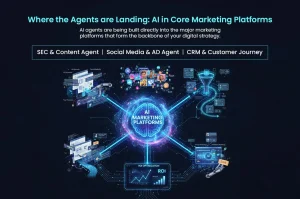
A. The SEO & Content Agent: From Strategy to SERP Domination
The world of SEO is no longer about manual keyword research and repetitive content creation. AI agents are transforming how we approach organic growth.
- Keyword Intelligence & LSI: An agent no longer just tells you the search volume of a short-tail keyword like “AI Marketing.” Instead, it analyzes the top-ranking pages, identifies the knowledge gaps, and suggests a cluster of LSI keywords (like machine learning for SEO or Google’s E-E-A-T guidelines) that you need to include to achieve topical authority.
- Real-Time Optimization: Imagine an agent constantly monitoring your high-traffic pages. If it detects a sudden drop in a key ranking, it doesn’t wait for your weekly report. It immediately analyzes the competitor’s new page, suggests the missing subheadings, and even drafts the new, optimized paragraphs for your human editor to approve. This is workflow optimization in action.
- Internal Linking & Site Health: Agents are now automating technical SEO tasks, such as finding the most relevant, high-authority pages on your site to link to a new blog post, instantly boosting its authority.
B. The Social Media & Ad Agent: Hyper-Personalization at Scale
Social media used to be a labour-intensive cycle of planning, posting, and manually analyzing comments. Now, AI agents are taking over the full lifecycle of a campaign.
- Audience Segmentation & Targeting: Forget broad demographic targeting. Agents are using predictive analytics to analyze real-time behaviour (what people are clicking, watching, and sharing right now) to create micro-segments on the fly. An agent might dynamically shift budget to a segment of “recent viewers of competitor content who live within a 10km radius of your store,” resulting in unparalleled hyper-personalization.
- Dynamic Creative Optimization (DCO): This is one of the biggest leaps. An ad agent can test hundreds of combinations of a single ad—different headlines, images, calls-to-action—and automatically use the highest-performing variant for each unique user impression. It’s like having an entire creative team running A/B/C/D…Z tests 24/7.
- 24/7 Engagement & Sentiment Analysis: AI agents are powering advanced chatbots that don’t just answer FAQs. They analyze the sentiment of a comment (“This product is amazing!”) and auto-generate an authentic, on-brand response, or flag a high-priority negative comment for a human to handle, ensuring your social media marketing is always active and professional.
C. The CRM & Customer Journey Agent: The Best AI Tools for Personalized Customer Journeys
The goal of marketing is to move a prospect through a funnel. AI agents are becoming the engine of that funnel, connecting data from every touchpoint.
- Lead Scoring and Nurturing: An agent can monitor a lead’s behaviour—their email opens, website pages visited, resources downloaded—and instantly assign a real-time lead score. If a score jumps above a certain threshold (e.g., they downloaded a high-intent PDF), the agent automatically triggers a personalized sequence: a different email, a targeted retargeting ad, and a notification to the human sales rep.
- Churn Prediction: Using Machine Learning, AI agents analyze patterns in past customer data to forecast which customers are likely to leave (churn). They then automatically trigger a proactive “save” campaign—perhaps a special discount, a customer survey, or an invitation to a free consultation—before the customer even realizes they are thinking of leaving.
- Attribution Modelling: Tying a conversion back to the original source has always been messy. AI agents can track the multi-touch customer journey across platforms, assigning accurate credit and helping you answer the informational question: “Which marketing channel is truly driving the highest ROI?”
3. The Marketer’s New Mandate: From Doer to Director
If AI agents are handling the repetitive, data-heavy, and optimizing tasks, what’s left for the human marketer? Everything important, in fact. The rise of the agent marks a clear, exciting shift in our job description: from Doer to Director.
Focus on High-Value, Human-Centric Work
- Creative Vision and Brand Story: No AI agent can capture the soul of your brand, feel the emotional pulse of your audience, or invent the next viral campaign idea. The human marketer’s value shifts entirely to high-impact creative direction, storytelling, and building authentic connection.
- Strategy and Goal Setting: Agents need a goal. They need to be told what to optimize for. The human strategist must set the high-level objectives—the 1-year and 5-year plans, the brand position, the ethical guardrails, and the overall narrative.
- Prompt Engineering & Agent Oversight: Your new skill is less about writing ad copy and more about writing the perfect prompt or setting the perfect goal for your agent. You will manage the agent, review its data, and hit the ‘kill switch’ if it veers off-brand or exceeds a budget limit. You are the conductor of the AI orchestra.
Addressing the Elephant in the Room: The “AI-Generated” Content Fear
A valid concern is that a flood of AI-generated content will dilute quality and bore the reader. Our DigitalDhruv philosophy is simple: Don’t use AI to write; use AI to research, optimize, and scale the human-written message.
Your content must not look like AI-generated content. It must feel like a human wrote it—with empathy, wit, and unique insights. An agent can give you 100 perfect headlines, but you must choose the one that sparks genuine curiosity and delivers the brand’s voice.
4. Your Roadmap: Getting Started with Autonomous AI
The technology is moving fast, but implementation doesn’t have to be a confusing, expensive overhaul. Here is your action plan to start leveraging AI Agents responsibly:
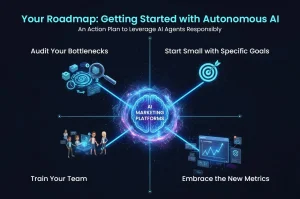
- Audit Your Bottlenecks: Identify the most time-consuming, repetitive, and data-intensive tasks in your current workflow. Is it audience segmentation? Daily ad bid adjustments? Writing a hundred variations of a cold email? These are the first jobs to hand off to an agent.
- Start Small with Specific Goals: Don’t try to automate your entire department. Start with one clear, measurable objective. For example: “Implement an AI agent to increase the email open rate by 5% through optimal send-time prediction.”
- Train Your Team: This technology is a partner, not a replacement. Invest in training your existing team in AI Prompt Engineering and Predictive Analytics. The best marketers will be those who can direct the agents effectively. The Digital Dhruv Institute is built specifically to train you on these next-generation skills.
- Embrace the New Metrics: Stop measuring hours spent and start measuring goal attainment. An agent’s success isn’t that it wrote 100 emails; its success is that it generated 20 qualified leads from those emails.
Conclusion: The Final Word from DigitalDhruv
The AI Tools & Agents Hitting Marketing Platforms are not just a trend; they are the new infrastructure. They are fundamentally redefining the playing field for every business, from a solo consultant to a global enterprise.
For too long, digital marketing has been about managing complexity—wrestling spreadsheets, manually optimizing campaigns, and trying to keep up with an ever-changing landscape. AI agents offer a profound liberation: they handle the complexity so you can focus on creativity, strategy, and human connection.
The future of marketing is not about working harder; it’s about directing smarter. At DigitalDhruv, we are ready to guide you in becoming the director of your new, powerful, AI-driven marketing orchestra.
Are you ready to stop chasing trends and start leading the Digital Marketing Future?