
You are running Facebook and Instagram ads for your business. The campaign is getting clicks, people are filling out forms, inquiries are coming through, and your marketing dashboard looks active.
But then the sales team asks a frustrating question:
“Where are the customers?”
This is where many businesses misunderstand digital advertising. They assume that every campaign should directly generate sales. When it doesn’t, they conclude that Facebook or Instagram ads are not working.
In reality, the problem may be much simpler: you may be using the wrong campaign objective for the stage of the customer journey.
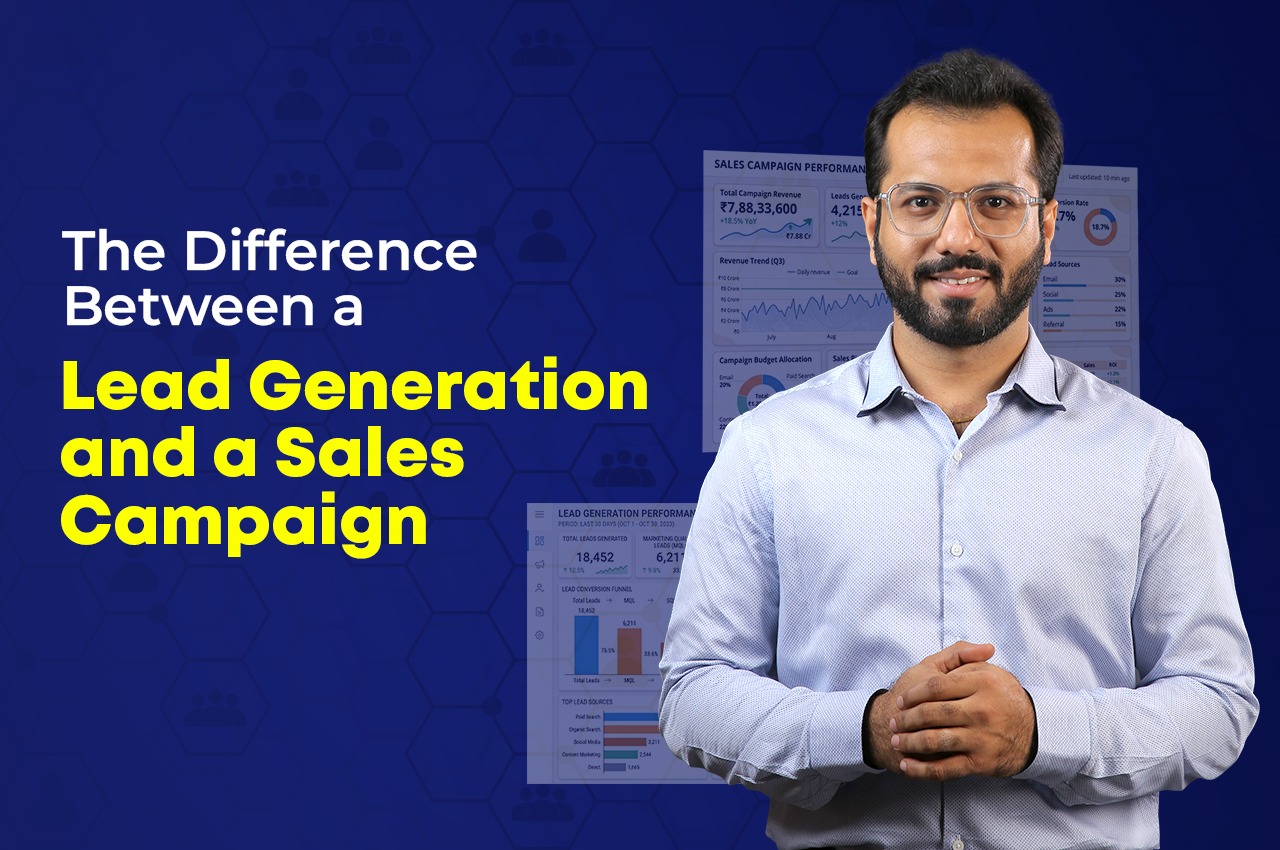
A lead generation campaign and a sales campaign can both be designed to generate business, but they are built for different purposes. One focuses on identifying and capturing potential customers; the other focuses on getting customers to complete a purchase or another valuable conversion.
Understanding the difference between lead generation vs sales campaigns is important for businesses investing in Facebook Ads, Instagram Ads, performance marketing, and online customer acquisition.
For a healthcare clinic, for example, a lead generation campaign may encourage someone to request an appointment. For an e-commerce brand, a sales campaign may take a customer directly to a product page and encourage them to purchase.
The right choice depends on your business model, customer journey, buying intent, and the amount of information a customer needs before making a decision.
Let’s understand the difference in practical terms.
What Is a Lead Generation Campaign?
A lead generation campaign is designed to identify people who are interested in your product or service and capture their contact information or inquiry.
The important word here is potential.
A lead is not necessarily a customer. It is someone who has shown enough interest to give your business a way to continue the conversation.
For example, imagine a real estate company promoting a new residential project in Surat. A person sees an Instagram advertisement showing the project’s location, amenities, and apartments. They are interested but are not ready to purchase immediately.
Instead of asking them to buy an apartment straight away, the business can invite them to:
“Get the Price List”
or
“Book a Site Visit”
The person submits their name and phone number.
That person is now a lead.
The business can then have a sales representative contact them, understand their requirements, answer questions, share pricing, and eventually try to convert them into a buyer.
This is the fundamental purpose of lead generation advertising.
When Does Lead Generation Make Sense?
Lead generation is particularly useful when the customer needs a conversation before making a decision.
This is common in industries such as:
- Real estate
- Healthcare
- Education
- Financial services
- Professional services
- B2B businesses
- High-value products
- Startups and specialized services
A person considering a ₹50 lakh property is unlikely to make the decision from one Instagram advertisement.
Similarly, someone looking for a medical consultation may first want to understand the doctor’s expertise, treatment options, location, availability, and consultation process.
In these situations, the lead is the beginning of the sales process, not the end of it.
What Is a Sales Campaign?
A sales campaign is designed to encourage a customer to complete a purchase or another defined conversion directly.
Instead of simply asking:
“Are you interested?”
the campaign is designed around:
“Complete the action now.”
For example, an e-commerce brand selling skincare products may show an Instagram ad featuring a particular product with a clear offer. The customer clicks the advertisement, visits the product page, adds the product to their cart, and completes the purchase.
There is no requirement for a salesperson to call them and explain the product individually.
The digital journey itself handles most of the conversion.
This is where sales campaigns can be extremely powerful.
They work particularly well when customers can make decisions relatively quickly and the website or online buying process is already optimized.
When Does a Sales Campaign Make Sense?
Sales-focused advertising can be effective for:
- E-commerce products
- Consumer products
- Food delivery
- Online courses
- Tickets and bookings
- Subscription products
- Established brands with strong customer demand
However, that does not mean a sales campaign is automatically the better option.
The real question is:
How does your customer normally buy?
If customers need a salesperson, consultation, demonstration, site visit, or detailed explanation, a lead-focused strategy may be more appropriate.
If customers can understand the product and purchase it online within a few minutes, a sales campaign may make more sense.
Lead Generation vs Sales Campaign: The Core Difference
The simplest way to understand the difference is to look at what happens after the customer responds to the advertisement.
With a lead generation campaign, the advertisement starts a conversation.
With a sales campaign, the advertisement tries to complete the transaction.
Consider a real estate company.
A lead generation campaign might say:
“Explore 2 & 3 BHK Homes in Surat. Get Brochure & Pricing.”
The customer submits their information. The sales team then takes over.
A sales campaign for an e-commerce company might say:
“Shop Our New Collection — 20% Off Today.”
The customer clicks, visits the website, and purchases.
Both are performance marketing campaigns. Both can generate revenue. But the conversion mechanism is completely different.
The Customer Journey Determines the Campaign
One of the biggest mistakes businesses make is selecting a campaign objective based on what they want instead of how their customers actually behave.
Every customer goes through some form of decision-making process.
A person may first discover your business, become interested, research alternatives, compare prices, ask questions, and then finally make a purchase.
The longer and more complicated this journey is, the more important lead nurturing becomes.
For example, consider a patient searching for a specialized medical treatment.
They may see an advertisement, visit the clinic’s Instagram profile, read about the doctor, look at patient information, search for reviews, speak with their family, and finally call the clinic.
Expecting that person to make a direct purchase from the first advertisement is unrealistic.
A lead generation campaign makes more sense because it allows the business to establish contact and continue building trust.
Now compare that with someone shopping for a pair of shoes online.
They may already know what they want. They see the product, check the price and reviews, and purchase.
A sales campaign is much more appropriate.
The campaign should match the buying journey.
Lead Generation Does Not Mean “More Leads at Any Cost”
Another common misconception is that the best lead generation campaign is the one that produces the highest number of leads at the lowest cost.
Not necessarily.
Suppose Campaign A generates 500 leads at ₹100 per lead.
Campaign B generates 100 leads at ₹400 per lead.
At first glance, Campaign A appears to be the winner.
But suppose only 5 of Campaign A’s leads become customers, while 20 of Campaign B’s leads become customers.
Suddenly, the cheaper campaign isn’t necessarily better.
This is why businesses should move beyond cost per lead and evaluate lead quality and revenue generated.
A successful lead generation campaign should attract people who have a realistic possibility of becoming customers.
This is especially important for real estate, healthcare, education, and other industries where sales teams spend considerable time following up with each inquiry.
Why Sales Campaigns Need Strong Conversion Infrastructure?
A sales campaign cannot compensate for a poor buying experience.
Imagine an e-commerce company spending heavily on Instagram advertising but sending customers to a slow website with confusing navigation, unclear pricing, and a complicated checkout process.
The advertisement may be excellent.
The targeting may be excellent.
But the customer still won’t purchase.
This is why sales campaigns need a strong conversion ecosystem behind them.
The website needs to make it easy for customers to understand the product, evaluate the value, trust the business, and complete the purchase.
The same principle applies to online bookings, course registrations, restaurant orders, and other direct-response campaigns.
Advertising creates the opportunity. The conversion experience closes it.
How Lead Generation and Sales Campaigns Can Work Together?
Businesses don’t always have to choose one or the other.
In fact, some of the strongest digital marketing strategies use both.
Imagine an educational institute launching admissions for a new course.
The first campaign could introduce the course to prospective students and parents and generate inquiries from people who want more information.
Once the institute has collected enough audience data, it can continue communicating with those prospects through follow-ups, remarketing, testimonials, student success stories, and course information.
For audiences who are already familiar with the institute and have demonstrated strong interest, a more conversion-focused campaign can encourage them to complete the registration process.
In other words:
Lead generation can create the pipeline. Sales campaigns can help move qualified prospects toward conversion.
This combination becomes particularly valuable when the buying cycle is longer.
Which Campaign Should Your Business Choose?
There is no universal answer.
The right campaign depends on your product, price, customer journey, and sales process.
Choose Lead Generation When:
Your customer usually needs:
- A consultation
- A phone call
- A demonstration
- A site visit
- A quotation
- Additional information
- Personal assistance before purchasing
For example, a real estate developer is usually better served by generating qualified property inquiries than expecting users to purchase directly from an advertisement.
A healthcare clinic may want appointment inquiries rather than a traditional online product purchase.
An educational institute may need student or parent inquiries before enrollment.
Choose Sales Campaigns When:
Your customer can realistically:
- Understand the product online
- Compare the offer
- Make a purchase quickly
- Complete payment digitally
- Convert without speaking to a salesperson
This is particularly relevant to e-commerce and other businesses with a straightforward online checkout process.
What About Businesses That Need Both?
Many businesses operate somewhere in the middle.
For example, a restaurant may accept direct online orders while also using Instagram to build an audience and promote special offers.
An online education brand may sell lower-priced courses directly while using lead generation for high-value programs.
A real estate business may use lead generation for new prospects while running conversion-focused campaigns to audiences who have already interacted with the project.
This is why campaign strategy should not be based simply on choosing an option inside an advertising platform.
It should begin with understanding the business model and customer journey.
How Digital Dhruv Approaches Campaign Strategy
At Digital Dhruv, the focus is not simply on launching Facebook or Instagram campaigns.
The bigger question is:
What should the campaign achieve for the business?
For one business, that may mean generating qualified inquiries.
For another, it may mean increasing online purchases.
For another, it could mean building an audience first and converting that audience through retargeting.
As a Surat-based digital marketing consultancy and performance marketing agency, Digital Dhruv works with local businesses, healthcare clinics, real estate businesses, restaurants and cafés, e-commerce brands, educational institutes, startups, and SMEs.
The strategy is built around the business objective rather than treating every account the same way.
This distinction matters because a campaign can have impressive numbers and still fail commercially.
A business owner doesn’t ultimately need more clicks.
They need more meaningful business outcomes.
The Metrics You Should Actually Watch
The right metrics depend on the campaign objective.
For lead generation campaigns, businesses should look beyond the number of forms submitted. Important metrics include lead quality, cost per qualified lead, lead-to-customer conversion rate, response time, and ultimately revenue generated from those leads.
For sales campaigns, businesses should pay closer attention to purchase conversion rate, customer acquisition cost, return on ad spend, average order value, and revenue.
This prevents a common problem in digital marketing: celebrating activity instead of measuring actual business performance.
A campaign generating thousands of interactions may look successful in a monthly report, but if those interactions aren’t contributing to revenue, the business needs to reconsider the strategy.
FAQs About Lead Generation and Sales Campaigns
What is the difference between a lead generation campaign and a sales campaign?
A lead generation campaign focuses on collecting information from potential customers so the business can follow up with them. A sales campaign focuses on encouraging customers to complete a purchase or another direct conversion.
Is a lead generation campaign better than a sales campaign?
Neither is universally better. The right campaign depends on how customers make purchasing decisions. Businesses with longer sales cycles often benefit from lead generation, while businesses with simple online purchasing journeys may benefit more from sales campaigns.
Are Facebook Ads good for lead generation?
Yes. Facebook and Instagram advertising can be effective for generating targeted inquiries when the audience, offer, creative, and follow-up process are properly aligned.
Are Instagram sales campaigns suitable for e-commerce businesses?
They can be highly effective because customers can discover products, evaluate them, and purchase online. However, campaign performance also depends on product-market fit, creative quality, pricing, website experience, and conversion optimization.
How do I know whether my leads are good quality?
Don’t judge lead quality only by cost per lead. Look at how many leads are reachable, relevant, genuinely interested, and eventually converted into paying customers.
Can a business run both lead generation and sales campaigns?
Yes. Many businesses use lead generation to build their prospect pipeline and sales or conversion-focused campaigns to move qualified audiences toward a purchase.
Final Thoughts
The difference between a lead generation campaign and a sales campaign comes down to one fundamental question:
What does your customer need to do before they are ready to become a customer?
If they need a conversation, consultation, quotation, site visit, or additional information, lead generation may be the right starting point.
If they can understand your offer and purchase directly, a sales campaign may be more appropriate.
But the smartest digital marketing strategies go beyond simply selecting a campaign objective. They connect advertising with the entire customer journey — from the first interaction to the final conversion.
That is where performance marketing becomes meaningful.
At Digital Dhruv, we help businesses build Facebook and Instagram advertising strategies around measurable business objectives — whether that means generating better leads, increasing sales, improving conversion rates, or building a more predictable customer acquisition system.
Don’t choose a campaign because it sounds right. Choose it because it matches the way your customers actually buy.
Ready to Build a Better Advertising Strategy?
Talk to Digital Dhruv about your business goals and create a campaign strategy focused on qualified leads, conversions, and measurable ROI — not just clicks and impressions.