
It’s Not the Algorithm — It’s the Foundation
Digital marketing has made it possible for any business — big or small — to reach thousands of potential customers in minutes. Yet despite having access to powerful platforms, advanced tools, and endless online resources, many businesses still struggle to generate consistent leads and sales.
They run ads.
They post content.
They boost reels.
They hire freelancers.
And still… results don’t come.
So what’s really going wrong?
The truth is, most digital marketing failures don’t happen because the platform doesn’t work. They happen because the foundation is weak.
Let’s break down the real reasons.
1. No Clear Goals — Just Activity
One of the biggest digital marketing mistakes businesses make is confusing activity with strategy.
Posting daily isn’t a strategy.
Running ads isn’t a strategy.
Boosting posts isn’t a strategy.
Without clearly defined objectives — such as generating 100 qualified leads per month or achieving a 4X return on ad spend — marketing becomes random effort.
When there’s no clarity on:
- Who the target customer is
- What action they should take
- What result defines success
- What budget is acceptable
…money gets spent without measurable returns.
Digital marketing should start with one question:
What exact business outcome are we trying to achieve?
2. No Structured Strategy or Funnel
Many businesses treat digital marketing as separate tasks instead of a connected system.
They post on Instagram.
They run Facebook ads.
They build a website.
But none of these elements are aligned.
A strong digital presence follows a journey:
Awareness → Interest → Trust → Conversion → Retention
If you push sales before building trust, people ignore you.
If you create awareness but no follow-up, leads disappear.
If you run ads without nurturing, conversion rates drop.
An effective lead generation strategy doesn’t just focus on attracting traffic — it focuses on guiding that traffic toward becoming paying customers.
Without a funnel, marketing feels inconsistent and unpredictable.
3. Poor Audience Understanding

Targeting the wrong audience is one of the fastest ways to waste budget.
Many businesses either:
- Target too broadly without clarity, or
- Narrow down audiences based on guesswork.
Effective performance marketing depends on deep audience research. You must understand:
- What problems your customer is facing
- What motivates them to buy
- What objections they have
- Where they spend time online
Digital marketing success is rarely about “more reach.”
It’s about reaching the right people with the right message.
When audience alignment improves, conversion rates naturally increase.
4. Weak or Low-Quality Content
In today’s digital environment, attention is limited. If your content does not capture interest within seconds, it gets ignored.
Many brands still rely on:
- Generic sales graphics
- Overused captions
- Hard-selling posts
- Poorly designed creatives
Modern consumers expect value. They want:
- Education
- Entertainment
- Inspiration
- Solutions
Video content, storytelling, and relatable messaging now outperform plain promotional posts. If your content doesn’t provide value or create connection, it won’t build trust — and without trust, sales become difficult.
Strong social media marketing tips always emphasize one thing:
Sell less. Help more.
5. Inconsistency and Lack of Patience
Digital marketing rewards consistency.
But many businesses start enthusiastically and stop quickly when they don’t see immediate results. They run ads for a few days, see limited returns, and shut everything down.
The reality is, digital marketing requires testing, refinement, and learning. Campaigns need time to collect data. Audiences need repeated exposure to build trust.
Inconsistent posting and frequent campaign interruptions damage momentum and reduce brand credibility.
Growth requires discipline.
6. Ignoring Data and Analytics
Another major reason for online marketing failures is relying on assumptions instead of analytics.
Without tracking metrics such as:
- Click-through rates
- Conversion rates
- Cost per lead
- Drop-off points
…there is no way to optimize.
Digital platforms provide detailed data. When businesses ignore it, they miss opportunities to improve performance.
Data removes emotion from decisions.
Optimization begins where guesswork ends.
7. Weak Ad Optimization
Launching ads is simple. Scaling them profitably is where skill matters.
Many businesses:
- Don’t test different creatives
- Avoid A/B testing
- Increase budgets too quickly
- Stop campaigns before proper evaluation
Ad success rarely comes from a single attempt. It comes from structured testing — refining messaging, visuals, targeting, and offers over time.
Performance marketing is about continuous improvement, not instant perfection.
8. Poor Website or Landing Page Experience
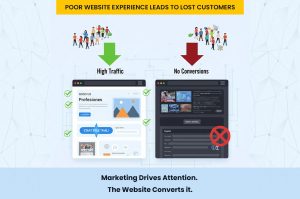
Sometimes ads are working — but conversions aren’t.
If your website:
- Loads slowly
- Looks unprofessional
- Has unclear calls-to-action
- Has complicated forms
…you will lose customers even if traffic is high.
Your customer acquisition strategy must include user experience. Marketing drives attention. The website converts it.
Even small improvements in clarity, design, and speed can significantly increase results.
9. Ignoring Mobile Optimization
Most digital traffic today comes from mobile devices. Yet many businesses design websites primarily for desktop users.
If your mobile experience is cluttered, slow, or difficult to navigate, users leave quickly.
Mobile-first design is no longer optional — it’s essential for survival.
10. Expecting Immediate Success
Digital marketing is not a shortcut to instant profit.
It requires:
- Testing
- Data collection
- Optimization
- Strategic adjustments
Businesses that expect instant results often quit before campaigns stabilize. Sustainable growth comes from consistency and refinement — not overnight success.
11. Lack of Trust and Brand Credibility
People don’t buy from brands they don’t trust.
If your business lacks:
- Reviews
- Testimonials
- Case studies
- Active engagement
- Clear brand personality
…conversions suffer.
Trust-building is a core part of any successful social media marketing tips strategy. Transparency, authenticity, and communication build confidence — and confidence drives sales.
12. Not Adapting to Change
Digital marketing evolves constantly.
New tools, AI systems, automation features, and video formats are reshaping strategies. Businesses that cling to outdated methods fall behind competitors who adapt faster.
Flexibility and learning are essential in digital growth.
13. Trying to Do Everything Alone
Many entrepreneurs try to manage content creation, ad campaigns, analytics, funnel design, and optimization by themselves.
Without expertise or time, mistakes multiply.
Sometimes, investing in education or professional guidance prevents costly trial-and-error losses.
The Real Reason Behind Failure
Most businesses fail in digital marketing because they treat it as a marketing tactic — not a structured growth system.
Success requires:
- Clear goals
- A defined funnel
- Strong audience research
- High-quality content
- Data tracking
- Continuous optimization
- Patience and consistency
When these elements align, digital marketing becomes predictable and scalable.
When they don’t, it becomes expensive and frustrating.
🎯 Want to Avoid These Mistakes and Learn Digital Marketing the Right Way?
Instead of wasting money on trial and error, learn step-by-step strategies from experts.
Join Digital Dhruv and get practical training on:
✅ Ads strategy
✅ Content creation
✅ Funnels
✅ Lead generation strategy
✅ Real campaign setup
Turn your marketing into real results 📈
👉 Contact Digital Dhruv today and start your digital marketing journey with confidence.
Final Thought
Digital marketing doesn’t fail businesses.
Unclear strategy, inconsistency, and poor execution do.
Build the right foundation — and the results will follow.